
The Tonneau Cover may earn a commission from Amazon purchases — at no extra cost to you. Our recommendations reflect our team’s evaluation, not affiliate payouts. Full disclosure →
Complete Tonneau Cover Sizing Guide for 2026: How to Measure Your Truck Bed Correctly

Getting the right tonneau cover size isn’t just about matching your truck model—it requires precise bed measurements and understanding manufacturer tolerances. In 2026, with over 40 truck bed configurations across major brands and aftermarket modifications becoming standard, accurate sizing prevents returns, installation headaches, and potential damage to both your cover and vehicle. Whether you’re installing a BAKFlip MX4 hard folding cover or a Retrax One MX retractable system, dimensional accuracy matters more than ever.
Our team has measured hundreds of truck beds across Ford, Chevy, Ram, GMC, and Toyota models, and we’ve identified the exact measurement points, common sizing errors, and manufacturer-specific quirks that separate perfect fits from expensive mistakes. This guide provides the measurement techniques professionals use, explains how bed liners and rail systems affect sizing, and shows you which top-rated tonneau covers offer the most forgiving installation tolerances for real-world truck beds.
What This Guide Covers
- Standard Bed Size Categories
- Essential Measurement Techniques
- Cover Type Fitment Requirements
- Common Sizing Mistakes
- Budget & Product Recommendations
- Frequently Asked Questions
Types to Know Before You Buy
Hard Folding Covers
Hard folding tonneau covers like the BAKFlip MX4 require precise bulkhead-to-tailgate measurements with less than 1/4-inch tolerance. These covers mount directly to bed rails and depend on parallel rail alignment for proper panel folding and sealing.
Pros: Rigid aluminum panels resist flexing across measurement variations, Visible panel alignment immediately reveals sizing issues, Clamp systems allow minor lateral adjustments, Most models accommodate spray-in liners up to 3/4-inch thick. Cons: No length adjustment once panels are cut to size, Bulkhead interference from toolboxes requires custom sizing, Panel weight makes test-fitting challenging, Rail height variations affect sealing on modified beds. Best for: Standard bed configurations with factory rails and no bulkhead modifications ($800 – $1,400).
Soft Roll-Up Covers
Soft roll-up models like the TruXedo TruXport and Gator EFX offer the most installation forgiveness, with fabric that accommodates minor bed irregularities and rail spacing variations up to 1/2-inch. These covers use tensioned fabric stretched between side rails.
Pros: Fabric tension system compensates for slight measurement errors, Side rail clamps adjust to accommodate width variations, Works with most bed liner types without modification, Easiest to return or exchange if initial sizing is incorrect. Cons: Visible sagging reveals improper rail spacing, Water pooling occurs when length measurements are off, Velcro strips require precise alignment for weather sealing, Fabric stretches over time, masking original sizing issues. Best for: Modified truck beds, vehicles with aftermarket accessories, or first-time installers ($250 – $500).
Retractable Covers
Retractable systems like the Retrax One MX demand the most precise measurements, requiring exact canister placement calculations and unobstructed rail surfaces along the entire bed length. These covers use aluminum slats that retract into a front-mounted canister.
Pros: Machined components ensure consistent fitment once sized correctly, Canister design accounts for specific bed length tolerances, Rail systems include micro-adjustment features, Premium models offer custom-sizing services. Cons: Canister placement requires bulkhead-to-canister measurements within 1/8-inch, No adjustment possible after canister installation, Rail obstructions or bed liner thickness can prevent operation, Most expensive to resize or return due to custom components. Best for: Unmodified factory beds with confirmed OEM dimensions and no cargo management systems ($1,200 – $2,000).
Tri-Fold Covers
Tri-fold designs like the Extang Trifecta 2.0 balance measurement precision with installation flexibility. Three-panel construction distributes dimensional stress across hinge points, allowing up to 3/8-inch variance in bed length while maintaining proper sealing.
Pros: Hinge points absorb minor length measurement errors, Lighter panels than bi-fold systems make test-fitting practical, Side rail clamps offer width adjustment up to 1/2-inch, Panel removal allows bed length verification before final installation. Cons: Hinge alignment reveals width measurement inaccuracies, Front panel must clear bulkhead with exact spacing, Bed liner thickness affects all three panel positions, Tailgate seal depends on rear panel placement precision. Best for: Standard to lightly modified beds where some measurement flexibility is needed ($400 – $750).
Key Features to Evaluate
Bed Length Measurement Points
Accurate bed length requires measuring from the inside of the closed tailgate to the front of the bed behind the cab bulkhead at the bed floor level, not the rail tops. For covers like the BAKFlip MX4, this measurement determines panel length and cannot be adjusted post-manufacture.
Bed Width and Rail Spacing
Width measurements must account for inner bed width at the widest point and outer rail spacing where clamps attach. Drop-in bed liners can reduce usable width by 1.5 inches per side, while spray-in liners add thickness that affects clamp positioning but not overall width.
Bed Rail Height and Profile
Rail height from bed floor to top edge determines seal effectiveness and clamp compatibility. Stock rails typically measure 1.5 to 2.25 inches, but aftermarket rails, bed liners, and stake pocket covers alter this critical dimension that affects every cover type.
Bulkhead Clearance and Interference
The space between the bed front and any installed accessories—toolboxes, headache racks, fifth-wheel mounts—determines front panel or canister placement. Retractable covers need 13-16 inches of unobstructed bulkhead space, while folding covers require 3-5 inches minimum.
Tailgate Integration and Seal Points
Tonneau covers seal against either the tailgate top edge or the bed-tailgate junction depending on design. Aftermarket tailgate accessories, spray-in liner overspray, and tailgate caps change these seal surfaces, requiring measurement of actual contact points rather than factory specifications.
Bed Liner Thickness and Material
Drop-in liners create stepped surfaces that affect clamp positioning and width calculations, while spray-in liners add 1/8 to 3/4-inch thickness to all surfaces. Line-X and Rhino liners often extend over rail edges, requiring thickness measurements at clamp locations, not just bed floor readings.
Common Mistakes to Avoid
Recommendations by Budget
Budget-Friendly
$250 – $500Soft roll-up covers that offer measurement forgiveness and easy returns if sizing issues arise.
 Top Pick Budget-Friendly
TruXedo TruXport
The TruXedo TruXport provides the most installation flexibility in this guide, with dual-latch side rails that accommodate width variations up to 1/2-inch and tensioned fabric that compensates for minor length discrepancies. The tear-resistant vinyl stretches slightly during installation, masking measurement errors up to 3/8-inch while maintaining weather sealing, making it ideal for first-time installers or beds with aftermarket modifications.
Check Price on Amazon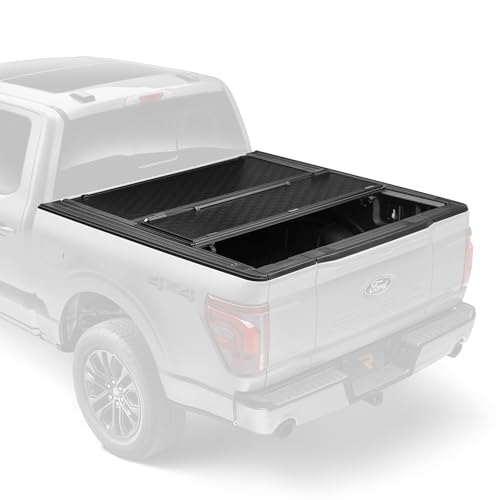 Tri-fold flexibility
Gator EFX
Three-panel design with hinge points that absorb length measurement variations while maintaining hard-cover protection and tool-free clamp installation that adjusts to rail spacing differences.
Check Price on AmazonMid-Range
$500 – $1,000Tri-fold hard covers that balance precision requirements with practical adjustment capabilities during installation.
 Top Pick Mid-Range
Extang Trifecta 2.0
The Extang Trifecta 2.0 uses automotive-grade hinges between its three aluminum panels to distribute dimensional stress, allowing proper fitment even with length measurements that vary up to 3/8-inch from specifications. The AutoLatch system self-adjusts to tailgate height variations, while rail clamps slide along the mounting channel to accommodate asymmetric bed widths. This design forgiveness makes it appropriate for beds with spray-in liners up to 1/2-inch thick without requiring measurement adjustments.
Check Price on Amazon Premium hard-folding
BAKFlip MX4
Aluminum panels with reinforced hinges require precise measurements but include position-adjustable clamps that compensate for rail spacing variations up to 1/4-inch per side.
Check Price on AmazonPremium
$1,200 – $2,000Retractable covers demanding exact measurements but offering superior functionality and custom-sizing options for modified beds.
 Top Pick Premium
Retrax One MX
The Retrax One MX represents the measurement-precision pinnacle, requiring bed length accuracy within 1/8-inch for proper canister placement and rail parallelism within 1/16-inch for smooth slat operation. The matte aluminum slats retract into a sealed canister that mounts at the bulkhead, demanding exact clearance measurements before purchase. However, this precision delivers unmatched functionality—the cover operates in any position, supports 500 pounds when closed, and seals completely against weather while accommodating spray-in liners through canister spacers included with professional installation packages.
Check Price on Amazon Hard-folding alternative
BAKFlip MX4
Offers near-retractable convenience with folding panels that require less precision than retractable canisters while providing similar aluminum construction and weight-bearing capabilities for active truck use.
Check Price on AmazonFrequently Asked Questions
Measure from the inside surface of the closed tailgate to the front bed wall at the bed floor level, not along the rail tops. Use a straight measuring tape pulled tight along the bed floor centerline, ensuring the tailgate is fully latched. This inside dimension is what manufacturers use for sizing charts—a measurement taken along the rails will be 2-4 inches too long and result in an incorrectly sized cover.
Spray-in liners add 1/8 to 3/4-inch thickness to all bed surfaces, including rails where clamps attach, but they don’t change the bed’s inside length or width dimensions. Measure your bed after liner installation to account for this thickness—most covers include clamp spacers for liners up to 1/2-inch thick, but retractable models may require canister spacers for proper operation. Drop-in liners reduce usable width by 1-3 inches and require measuring the liner’s interior dimensions, not the bed’s.
Bed width is the inside dimension between bed sides at the widest point, typically measured at bed floor level. Rail spacing is the outside distance between rail tops where cover clamps attach, usually 2-4 inches wider than bed width. Tonneau covers need both measurements—width determines if cargo will fit under the cover, while rail spacing determines clamp positioning and cover frame size. Always measure rail spacing at the front, middle, and rear of the bed since spacing can vary up to 1/2-inch along the bed length.
No—factory specifications like ‘5.5-foot bed’ are nominal designations that vary from actual dimensions by 1-3 inches depending on manufacturing tolerances, bed liner installation, and model year. A 2026 Ford F-150 with a ‘5.5-foot bed’ actually measures approximately 67.1 inches inside, while the marketing designation suggests 66 inches. Additionally, aftermarket modifications, collision repairs, and bed liners alter dimensions unpredictably. Physical measurement is mandatory for proper tonneau cover fitment.
Soft roll-up covers like the TruXedo TruXport tolerate 1/4 to 1/2-inch variations in length and width due to fabric tension systems. Tri-fold covers like the Extang Trifecta 2.0 accommodate 1/8 to 3/8-inch errors through hinge flexibility and adjustable clamps. Hard folding covers like the BAKFlip MX4 require precision within 1/4-inch since rigid panels can’t flex. Retractable systems like the Retrax One MX demand accuracy within 1/8-inch for length and 1/16-inch for rail parallelism because canister placement and slat operation depend on exact dimensions.
A 25-foot metal measuring tape with a locking mechanism provides the accuracy needed for bed length measurements—avoid cloth tapes that stretch. A carpenter’s square or framing square helps verify rail alignment and perpendicularity. A flashlight or headlamp illuminates measurement points inside the bed. For rail spacing and width, a straight edge or level ensures you’re measuring at consistent points along the bed. Mark measurement points with painter’s tape so you can double-check readings before ordering a cover.
Measure from the rear face of the toolbox or rack to the inside of the closed tailgate—this becomes your effective bed length. Most folding covers require 3-5 inches of clearance between the front panel and any bulkhead obstruction, while retractable covers need 13-16 inches for the canister. Some manufacturers offer short-bed or custom-length options specifically for reduced bed space. If your obstruction leaves less than 48 inches of usable bed length, consult with manufacturers about custom sizing or consider removing the accessory before installing the tonneau cover.
Truck beds aren’t manufactured with perfect symmetry—manufacturing tolerances allow 1/4 to 1/2-inch variation between sides. Collision repairs, frame flex, and uneven liner installation also create asymmetry. Most tonneau covers accommodate this through adjustable clamps that can be positioned differently on each side. Measure both rails at front, middle, and rear positions, then average the measurements for ordering. During installation, adjust clamps independently on each side to achieve proper alignment and sealing despite the dimensional differences.